
Affiliate disclosure: Canadian Budget Binder is a KOHO affiliate and may earn a commission if you register through a qualifying affiliate link. KOHO’s membership fees and optional-product charges may apply. This article compares both the benefits and the costs to help you decide what suits your household.
Every dollar matters when you’re shopping for groceries, paying for transportation, and keeping up with household expenses. KOHO combines a prepaid Mastercard with spending tools, cash back on eligible purchases, savings features, and interest on eligible balances. For a household that wants more control over everyday spending, those features can be useful—but the value depends on which plan you use and which benefits you actually need.
I’ve covered KOHO’s prepaid Mastercard and money-management features in my original KOHO review. For Financial Literacy Month, I want to look at KOHO through a practical household-budget lens: where can the account help, what could the rewards be worth, and when might paying for a higher cash-back rate cost more than it returns?
A free plan may be enough for someone who mainly wants prepaid spending control and eligible everyday cash back. A paid plan can make more sense when you genuinely use its broader benefits—not simply because a larger cash-back percentage looks better. The answer depends on what you buy, whether purchases qualify for rewards, the account options shown to you, and what you pay for them.
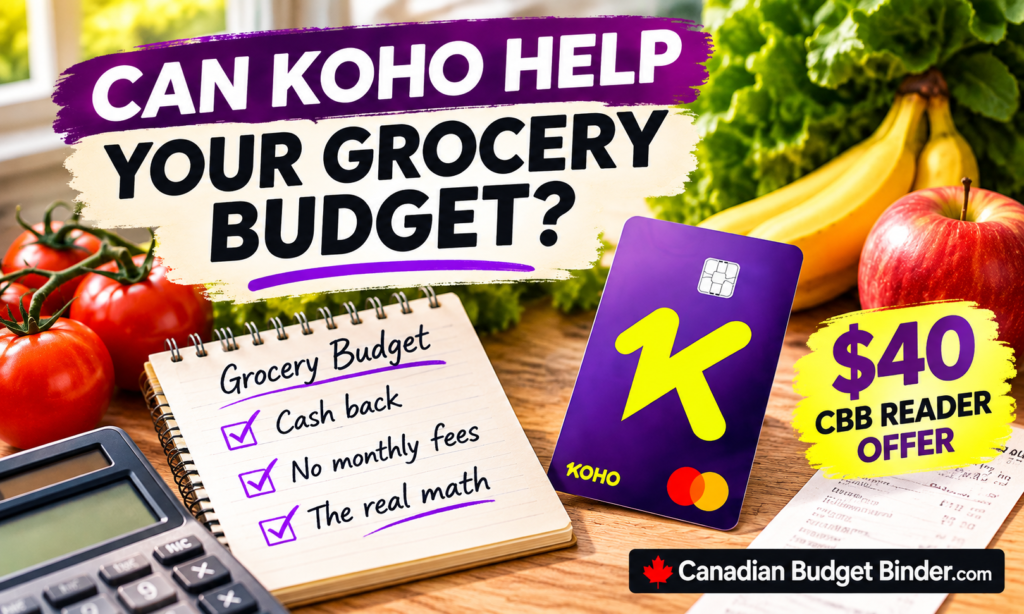
CBB Reader Offer: $40 KOHO Signup Bonus
For November 2026, new KOHO customers who register through Canadian Budget Binder’s promotional link can qualify for a one-time $40 signup bonus.
To qualify, register a new KOHO account through the CBB promotional offer and make your first KOHO card purchase of more than $20 CAD within 30 days of registration. The promotion is scheduled to run from November 1–30, 2026.
Use the CBB promotional link to sign up for KOHO and use promo code CBB4026 when you register. KOHO says the tracked link automatically applies the promo code, but we recommend checking that CBB4026 appears during signup so you know you are registering through the CBB offer.
KOHO says the one-time $40 bonus is credited to the customer’s KOHO account once the qualifying requirements are met. The offer is limited to new KOHO customers, may only be used once per person, is non-transferable, and cannot be combined with other KOHO offers or promotions. KOHO may change, suspend, or terminate the offer at its discretion.
A $40 signup bonus can make an offer more attractive, but it shouldn’t be the only reason you choose a financial account. The rest of this article looks at KOHO’s ongoing costs, rewards, and features after the promotional bonus is gone.
What Is KOHO?
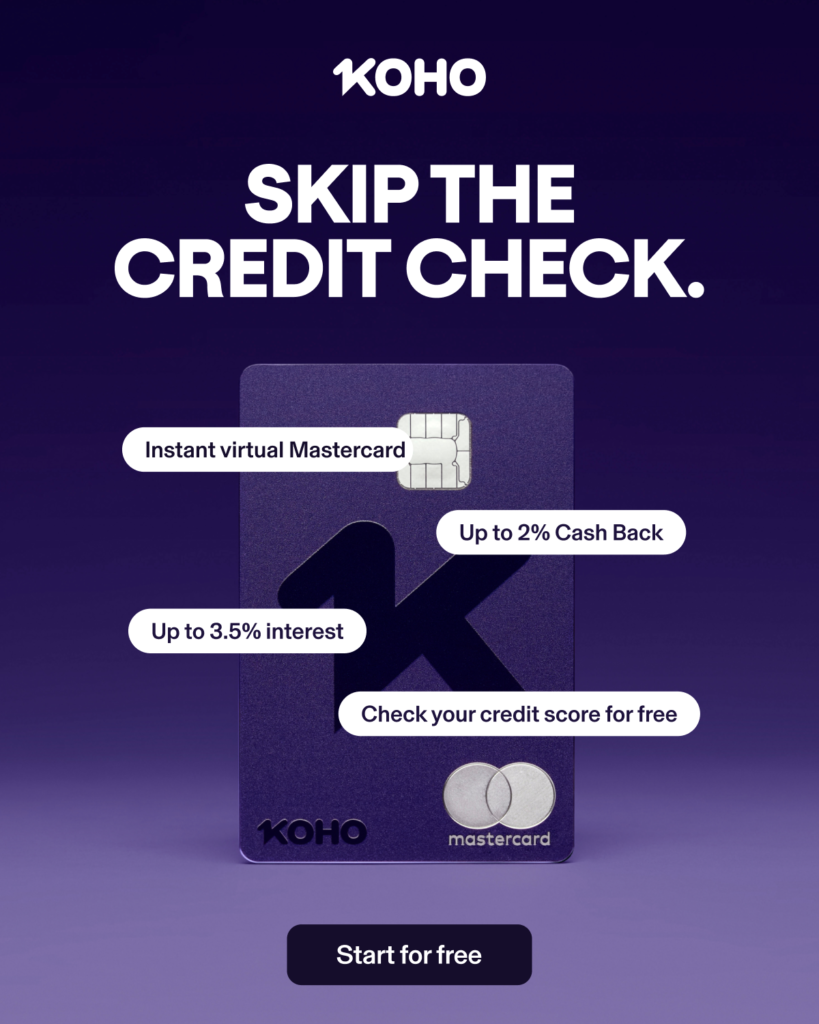
KOHO is a Canadian financial technology company offering a prepaid Mastercard and an app for everyday spending and money management. A prepaid card generally uses funds you’ve already put in the account rather than a revolving credit-card limit. Some KOHO products involving borrowing or credit building are separate and carry their own conditions.
Depending on your plan, KOHO offers transaction tracking, cash back on qualifying purchases, spending insights, savings tools such as RoundUps and Goals, and interest on eligible balances. None of those features replaces the need for a household budget.
Which KOHO Accounts Offer Grocery Cash Back?
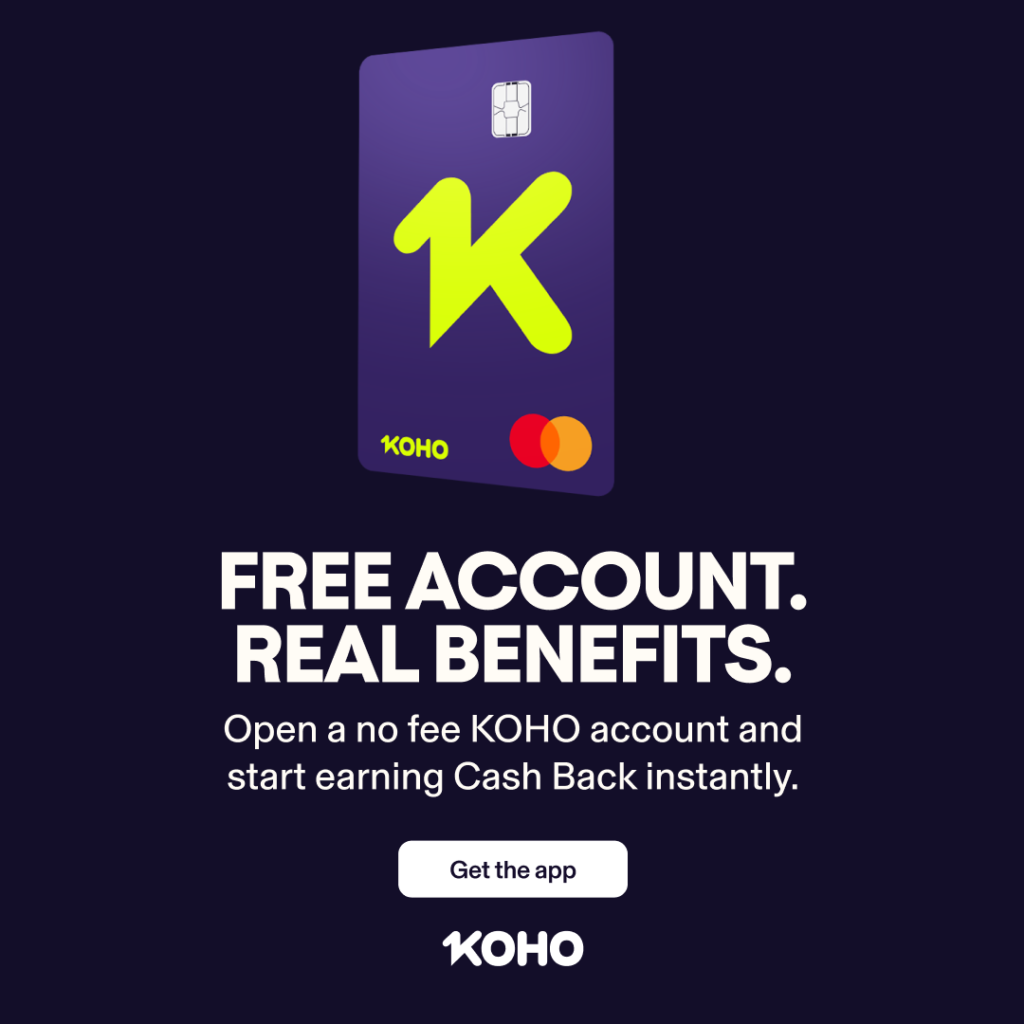
KOHO’s public account page currently advertises Core, Extra, and Everything, including a no-monthly-fee Core option. Its August 2026 help-centre materials also reference the older Essential and Non-Member options; an earlier Core help article describes a phased rollout. Check the exact account, price, and benefits shown to you at registration or in the KOHO app rather than assuming every customer sees the same options.
Here is an illustration using rates and prices displayed in KOHO’s public information in October 2026:
| Advertised plan | Cash back on qualifying grocery purchases | Standard monthly billing | Annual billing |
|---|---|---|---|
| Core, where available | 1% | $0 | $0 |
| Extra | 1.5% | $18/month | $144 paid upfront ($12/month equivalent) |
| Everything | 2% | $22/month | $177 paid upfront ($14.75/month equivalent) |
These are advertised rates for eligible purchases, not a promise that every purchase at a store selling groceries will qualify. KOHO says pricing and rates can change, and customers should check the app for their current offer. Its older Essential plan may have its fee waived after qualifying activity; those conditions differ from the no-monthly-fee Core offering.
What Would $800 in Monthly Grocery Spending Earn?
Let’s imagine a household that already plans to spend $800 each month on groceries, all at merchants whose purchases qualify for the category rate. The family neither increases spending to chase rewards nor changes plans during the year.
| Plan | Monthly grocery rewards | Annual grocery rewards | Annual plan cost if paid yearly | Grocery rewards less annual plan cost |
|---|---|---|---|---|
| Core | $8 | $96 | $0 | +$96 |
| Extra | $12 | $144 | $144 | $0 |
| Everything | $16 | $192 | $177 | +$15 |
These figures are an illustration of grocery rewards minus the annual subscription cost, not total household savings. They leave out other purchase categories, interest, benefits, taxes where relevant, and other fees. The table assumes the annual plan prices, paid upfront; month-to-month subscriptions cost more over a full year.
For balance, KOHO also advertises 0.25% cash back on eligible purchases outside the main everyday categories with Extra, and 0.5% with Everything. Core does not advertise a standard base rate on those other purchases. These extra rewards can improve the value of a paid plan—but only for purchases that qualify and that you were already planning to make. Always compare the total benefit, not just one category.
What If Only Half Your Grocery Spending Qualifies?
The first table assumes that all $800 of monthly grocery spending earns the advertised category rate. Here’s a reality check: if merchant classification means only $400 per month earns grocery rewards, the annual rewards minus the published upfront annual plan fee would instead be:
| Plan | Annual qualifying grocery rewards | Annual plan fee | Grocery rewards after plan fee |
|---|---|---|---|
| Core | $48 | $0 | +$48 |
| Extra | $72 | $144 | −$72 |
| Everything | $96 | $177 | −$81 |
Again, these are illustrative grocery-only results, not forecasts or a verdict on all account features. Nothing is earned on the remaining $400 in this example at the grocery-category rate; a purchase might qualify for a different standard rate, which we have not counted. The point is to check your actual eligible transactions before assuming that a higher cash-back plan will pay for itself.
At $800 of eligible groceries per month, Extra earns only $4 more per month than Core; Everything earns $8 more per month than Core. Against the regular monthly fees, those incremental rewards fall short by $14 for either plan. Even at discounted annual pricing, the grocery-reward difference alone does not cover the paid membership cost at that spending level.
For extra grocery cash back alone to offset the standard monthly membership fee relative to a free 1% Core account, a household would need approximately $3,600 of eligible spending per month for Extra or $2,200 for Everything. Under the published annual prices, the comparable thresholds are approximately $2,400 and $1,475 per month, respectively. These are break-even calculations, not spending targets.
If a paid plan’s other features genuinely save you money, include that value in your own comparison. But don’t upgrade just because 2% sounds better than 1%.
Could Higher Savings Interest Change the Answer?
Yes. If you keep a steady balance in an account that is actually eligible to earn interest, the interest-rate difference may be worth more than the extra grocery cash back. For illustration, consider a hypothetical average balance of $10,000 for a full year at constant advertised rates:
- At Core’s 2% annual rate, the approximate interest would be $200.
- At Extra’s 2.5% rate, it would be $250—about $50 more than Core.
- At Everything’s 3.5% rate, it would be $350—about $150 more than Core.
These are simplified, before-tax illustrations, not interest forecasts. KOHO says interest is calculated daily and compounded monthly, so the actual amount on a steady balance may differ slightly from these simple, non-compounded calculations. Eligibility and enrolment conditions apply, balances fluctuate, and advertised rates can change. KOHO’s public pages and help articles do not describe interest activation identically, so confirm your own interest status in the app. Do not keep money in an account solely because of an advertised rate without considering access to funds, fees, and deposit protection.
In short, our grocery-only comparison answers one question: Which plan is most economical for grocery rewards? It does not determine which account is best for every saver or every household.
Not Every Grocery Purchase Will Qualify
Cash-back categories are based on the merchant category code assigned to the transaction. A store selling groceries can be coded as a general retailer instead of a supermarket. KOHO notes that a Walmart purchase, for example, may be classified as retail rather than groceries. Codes can vary by merchant, location, or terminal.
A cash-back estimate is therefore only as good as the number of qualifying purchases. KOHO also lists non-purchase transactions—including ATM withdrawals, e-Transfers, bill payments, and direct deposits—as ineligible for cash back. Before choosing a plan, look at where you actually shop and check KOHO’s current rules in the app.
Five Ways to Make Cash Back Fit Your Grocery Budget
1. Set your grocery limit first
Review a few months of receipts, statements, and cash purchases. Decide how much your household can realistically afford to spend on food. If the allowance is $600 per month, use that figure—not the maximum potential rewards—as your starting point. My simple spending log can help you keep track.
2. Plan meals and shop your kitchen
Check the fridge, freezer, and pantry before writing a list. Build meals around food you already own, compare flyer prices, and use ingredients that need eating first. Avoiding an unnecessary $15 purchase leaves the full $15 in your pocket. Buying it for 2% cash back would return only 30 cents.
3. Compare the actual price, not just the reward
Imagine the same product costs $8 at Store A and $7 at Store B. Even if Store A offers 2% cash back, that is only a 16-cent reward, making the effective cost $7.84. Store B is still cheaper. Compare unit prices, sizes, and discounts before considering rewards.
4. Track all spending—not just KOHO spending
KOHO’s transaction history may help you spot patterns, but a complete household budget must also count purchases made through other bank accounts, credit cards, and cash. A second spending app isn’t a substitute for the full picture. My guide to four expenses to consider before budgeting offers a broader framework.
5. Give earned rewards a purpose
KOHO says eligible cash back becomes available after the transaction settles. You can check and redeem available rewards in the app into your Spendable balance. Instead of buying something extra because you’ve earned cash back, consider putting the equivalent money toward a planned grocery bill, holiday-food budget, or emergency savings.
RoundUps Aren’t Free Cash Back
RoundUps move your own money into savings. If a purchase totals $36.40 and you choose a nearest-dollar RoundUp, the 60 cents set aside came from money you already had. Cash back is a separate reward for an eligible purchase; interest is a separate return on an eligible balance.
KOHO’s Goals, RoundUps, and Vault features can separate savings from your everyday Spendable balance. Money typically needs to be moved back to Spendable before regular purchases, although KOHO says amounts owed under applicable terms may still be collected from savings balances. Don’t confuse a savings bucket with an account that cannot be charged.
Watch the Membership and Other Fees
KOHO’s paid plans generally renew automatically. A free trial may convert to a paid subscription when it ends unless cancelled in time. KOHO’s plan-refund policy says plan purchases are non-refundable, with benefits continuing through the paid billing period. Annual billing usually means committing the full fee upfront. Separately billed products such as Cover or Credit Building may continue even if you cancel your main plan.
Also review any charges relevant to your habits—such as certain cash-deposit or account-funding methods, ATM fees, and foreign-currency transactions. The best choice depends on the entire cost of the account, not one reward percentage.
What About Interest and CDIC Protection?
KOHO’s current public account comparison advertises 2% annual interest for Core, 2.5% for Extra, and 3.5% for Everything on eligible balances. The public accounts page describes interest starting upon signup, while KOHO’s August help-centre comparison and deposit-protection explanation refer to opting into Earn Interest. Because those descriptions differ, check your own account’s activation, eligibility, and interest settings before assuming interest is accruing or that deposit-insurance conditions are met. KOHO describes interest as calculated daily and paid monthly, with variable rates subject to change. Interest income may have tax consequences.
KOHO is not a CDIC member institution. KOHO states that balances eligible for its Earn Interest program are placed in trust at one or more CDIC member institutions and may qualify for deposit insurance subject to disclosure and other requirements. According to the Canada Deposit Insurance Corporation, coverage can apply to eligible deposits held in trust for named beneficiaries, generally up to $100,000 per beneficiary at each member institution when applicable conditions are met.
Crucially, CDIC insurance protects eligible deposits if the CDIC member institution fails; it is not insurance against KOHO itself failing. KOHO says accounts not earning interest do not qualify for this protection. Confirm the arrangement before placing a substantial balance in any fintech account.
Frequently Asked Questions
Is KOHO Core free?
KOHO’s main website advertises Core with no monthly membership fee. Its help centre says Core availability may vary. Verify your choices during registration.
Does KOHO cash back work at Walmart?
Not automatically. Merchant category codes determine eligibility, and a particular location or terminal may be classified as general retail instead of groceries.
A qualifying Core account offers 1% cash back on eligible everyday categories with no monthly membership fee. KOHO also documents other account options, including Essential, with different conditions.
Are paid KOHO plans refundable?
KOHO’s published policy says plan purchases are non-refundable. Contact its support team if you think a charge was made in error, and check how to cancel before the next renewal.
Will rent, bills or e-Transfers earn grocery cash back?
No. KOHO’s general cash-back guidance excludes bill payments, e-Transfers and other non-purchase transactions. Eligible groceries must be processed as qualifying purchases with the right merchant classification. Check the applicable promotion terms for any special rewards.
Is KOHO the same as a traditional credit card, and will it build credit?
No. KOHO’s prepaid Mastercard generally draws on available funds instead of a revolving credit limit. Ordinary prepaid-card spending by itself does not build credit history. KOHO’s separate credit-building or borrowing products have their own conditions and may have additional costs or obligations.
Should I pay for a higher cash-back percentage?
Only after comparing the additional rewards and benefits against the fee, using your real spending and account needs. The highest advertised reward isn’t always the best deal.
Final Thoughts: Save First, Earn Rewards Second
KOHO can be useful when its prepaid spending structure, transaction tracking, savings tools, interest eligibility, or cash back fit the way your household already manages money. The strongest value is not necessarily the highest advertised reward rate; it is the combination of features you will actually use at a cost that makes sense for you. Cash back can help with everyday expenses, but it still works best alongside meal planning, price comparison, reducing food waste, and tracking purchases.
The goal isn’t to spend more to earn rewards. It’s to keep more of the money you worked hard to earn.
Have you compared what you actually earn from a cash-back program after account fees? I’d be interested to hear what works for your household.
Mr. CBB Canadian Budget Binder
Sources and further reading
- KOHO’s publicly advertised account features
- KOHO Core availability and opt-in details
- KOHO’s August 2026 plan comparison, including monthly and annual fees
- KOHO cash-back eligibility, exclusions and redemption
- KOHO plan refund and renewal policy
- KOHO savings tools and Spendable balance
- KOHO’s deposit protection explanation
- KOHO’s daily interest and monthly compounding explanation
- CDIC: How coverage works for fintech customers
Information reviewed and calculations rechecked November 3, 2026. KOHO’s accounts, prices, interest rates, rewards, and conditions can change. Check your current terms. This article provides general financial education, not personalized advice.